Beauty brands invest heavily in personalized online shopping experiences, but that same level of personalization often disappears inside retail stores, spas and salons. AI skin and hair consultations can bridge that gap, helping professionals recommend the right products while giving brands and partners a more consistent way to understand and engage shoppers.
Sources: McKinsey, State of Beauty 2025; Spa Business, 2017 survey of 400 US spa operators.
In short: Most beauty sales still happen outside ecommerce, where the recommendation a shopper gets depends on who happens to be on shift. A co-branded AI consultation gives every retail, spa and salon partner the same starting point: a guided skin or hair assessment, recommendations built on the brand's own logic, and a consented customer profile that both sides can follow up on.
A beauty brand can spend months refining how it recommends products online, then hand the same catalog to a retail counter or a treatment room and lose all of that logic at the door. The associate recommends what they know best. The esthetician finishes the facial and never mentions home care. The shopper leaves, and neither the partner nor the brand knows what they needed.
This guide covers why the in-person channel still deserves the investment, where consultations break down, what an AI consultation changes in a store, spa or salon, and how to roll one out without taking the customer relationship away from the partner.
Ecommerce is growing fastest. Most beauty is still sold somewhere else.
NielsenIQ's State of Beauty 2026 report found online beauty sales growing six times faster than in-store sales (NielsenIQ). Growth rate is not the same as share. McKinsey puts ecommerce at 26 percent of global beauty retail sales in 2024 and projects 31 percent by 2030 (McKinsey). That leaves roughly seven in ten beauty purchases happening somewhere other than online, even at the end of the decade.
For professional skincare and haircare brands the in-person channel matters even more, because it is where the product gets explained. A facial, a scalp treatment or a counter consultation is often the first time a shopper hears why a product suits them. If that moment goes well, the partner sells a routine and the brand gains a customer. If it does not, both lose the sale and learn nothing from it.
The weak point is rarely the product. It is the gap between what the brand knows and what happens on the shop floor.
Sources: Spa Business, Spa Retail research (2017); ISPA Snapshot Survey, Spring 2024.
An in-store AI skin or hair consultation is a guided assessment that a beauty brand configures centrally and adapts for each retail, spa or salon partner, who runs it as a shared, co-branded experience. An associate can lead it, or the shopper can complete it alone on a tablet or by scanning a QR code.
Use guided questions and optional AI skin analysis or AI hair analysis to capture concerns, goals and preferences.
Present suitable products, routines or treatments with the education needed to explain why.
Create a useful profile that supports partner follow-up, brand insight and future personalization.
Send results, promote reorders and support co-branded campaigns after the shopper leaves, often through segmented Klaviyo flows.
The professional stays in charge. The tool gives them a consistent starting point and a reason to talk about home care that does not feel like a sales pitch, because the recommendation comes from the shopper's own results.
The assessment reads visible skin or hair characteristics to guide product, routine and treatment choices. It is not a medical diagnosis and does not replace a clinical assessment by a qualified professional.
The same consultation logic works in both settings, but the moment it fits into is different.
| Retail: Stores, Counters, Kiosks, Pop-ups | Spas and Salons | |
|---|---|---|
| When it happens | While the shopper browses, with or without an associate | Before a treatment or chair-side |
| Main job | Help the shopper compare products and leave with a complete routine | Connect the service to the right at-home products |
| What the shopper leaves with | Product and routine recommendations, sent to them afterwards | A treatment and home-care plan |
| Follow-up | Results delivery and a route back to the online store | Retake, reorder and rebooking prompts between visits |
In retail the consultation often runs on a tablet at the counter, and some brands hand the shopper a printed copy of their routine. In a spa or salon it can sit before the appointment, with booking built into the flow, so the professional starts the session already knowing the client's concerns.
A partner program only lasts if the partner earns more from it. The consultation has to work for three people at once.
A personalized consultation with clear products, routines, treatments and next steps.
Insight into customer concerns beyond transaction data, staff who can recommend without memorizing the catalog, more product attached to services, and a reason for customers to return.
Consistent recommendations across locations, a view of demand by partner and region, and opted-in audiences for joint campaigns.
The brand's gain goes beyond sell-through. Offering partners a working engagement tool gives them a reason to prioritize the brand's range over another on the same shelf.
Each of these can be measured after rollout: consultations completed per location, opt-ins captured, products attached to treatments, demand by location, and repeat purchases.
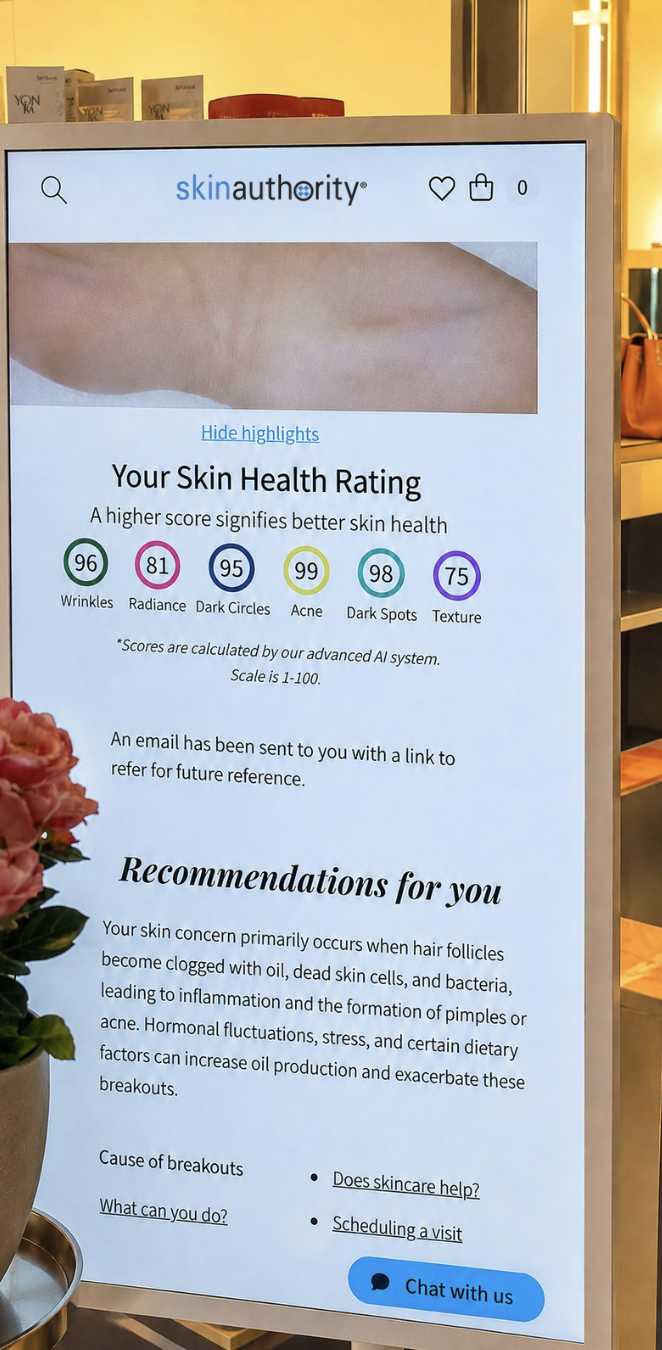
Skin Authority runs Tangent consultations in its retail and wellness partner locations.
“Tangent has helped us bring personalized skin consultations into our retail and wellness partner locations. It gives our partners a better way to understand each customer and create a stronger experience together.” Skin Authority
Tangent AI is a Shopify-native AI personalization platform for beauty brands, with skin and hair quizzes, selfie analysis and product recommendation tools. Its Retail, Spa & Salon program brings the same consultation into partner locations.
This is the question partners ask first, and the answer should be agreed before launch.
Two things govern it: what the shopper consented to, and what the commercial agreement between brand and partner says.
The model that works is shared, not extractive. The brand sets the experience, the partner runs it, and both see agreed reporting on needs, demand and recommendation activity. A brand that uses the consultation to pull customers away from the partner gives the partner every reason to stop offering it.
Handled well, a consultation at a partner location becomes one more source of zero-party data: information the shopper chose to give, with a clear record of who may use it.
The steps that matter most for a beauty brand launching its first partner consultations, in order.
It is a guided assessment a shopper completes at a retail, spa or salon location, using questions and an optional selfie analysis. It ends with product, routine or treatment recommendations based on rules the brand has approved.
No. The professional can guide the consultation and uses the result to explain their recommendation. A shopper can also complete it alone when no one is free.
A tablet at the counter or in the treatment room is the common setup. Shoppers can also open the consultation on their own phone through a QR code, which suits events and pop-ups.
Yes. The questions and recommendation logic stay the same, and the journey around them changes: product discovery in retail, treatment and home-care planning in a spa or salon.
Access and use follow the shopper's consent and the agreement between the brand and the partner. Settle both before launch.
The logic can be shared, but the setting is not. In person, a professional is present, the shopper can try the product, and the recommendation can include treatments as well as products.
No. It assesses visible skin or hair characteristics to guide product, routine and treatment recommendations. It does not diagnose conditions or replace a clinical assessment by a qualified professional.
Track consultations completed, opt-in rate, products sold per consultation or service, and whether those shoppers reorder or rebook.